

Restoring Auditability, Ballot Secrecy, and Chain of Custody Through Precinct-Based Voting
Implementing the ABC's of Election Security in YOUR local elections.

Introduction
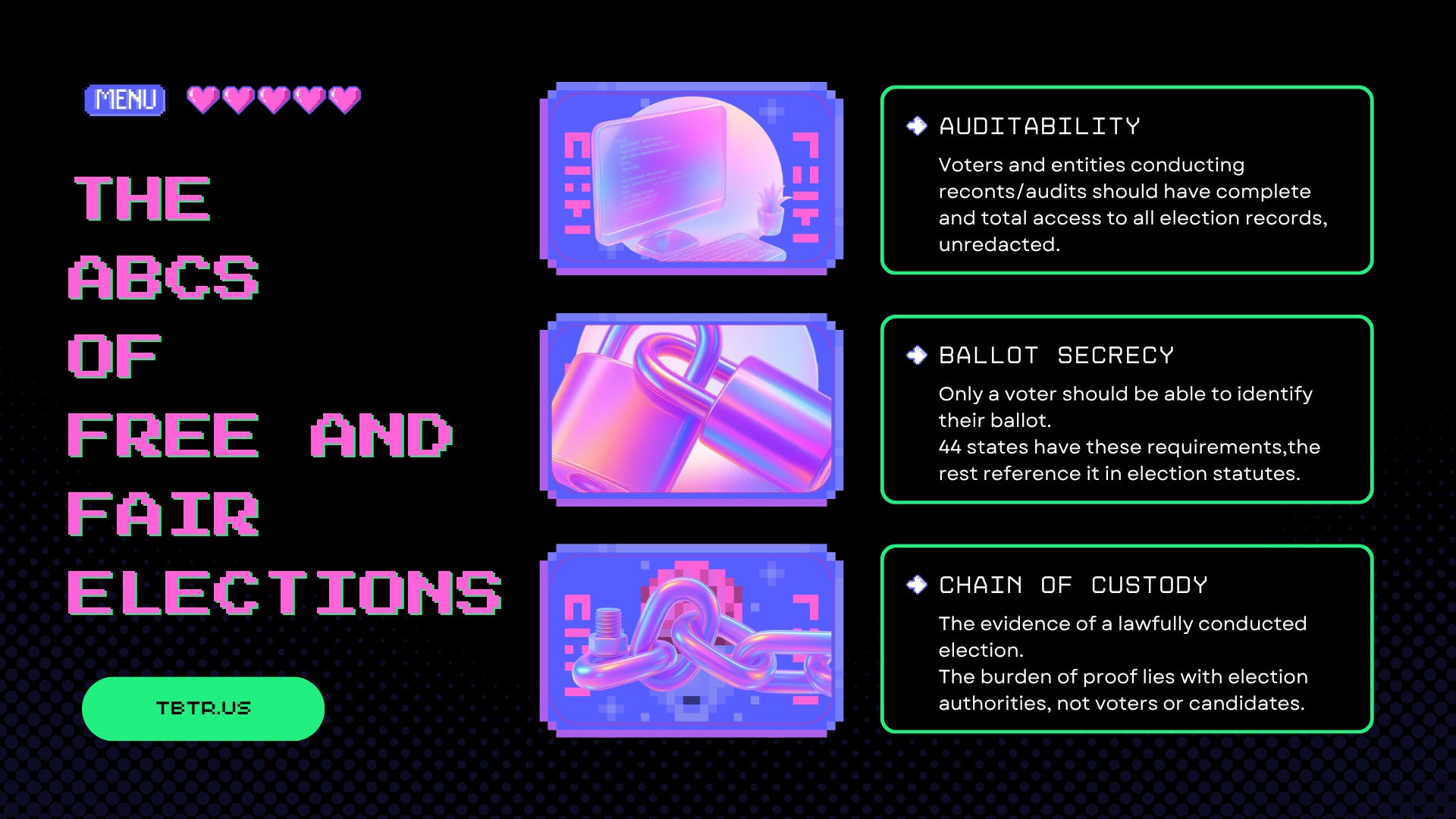
Citizen trust in election systems is essential to voter participation and confidence in election outcomes. Election procedures must not only be secure and accurate, but must also be transparent enough to allow meaningful public verification of election results. The principles of Auditability, Ballot Secrecy, and Chain of Custody form the foundation of election integrity and are necessary for citizens to independently verify that election outcomes accurately reflect the will of the voters.
The modern practice of allowing regular (non-provisional) ballots to be cast at any countywide vote center has created significant challenges to all three principles. While countywide voting centers were adopted to increase convenience, they have also eliminated the last voting option that inherently guaranteed ballot secrecy—in-precinct voting on Election Day. As a result, election administrators have been forced to redact a variety of election records to prevent the public from reconciling individual voters with their ballots, something that should not be possible under state and federal voting system standards.
The Problem
The need to redact election records has created a conflict between transparency and ballot secrecy. While ballot secrecy must always be protected, the resulting redactions prevent meaningful public examination of election records, hinder recounts, compromise audits, and weaken the chain of custody associated with precinct returns. Election records that should be available for verification become difficult or impossible to reconcile, limiting the public’s ability to independently confirm election accuracy.
These concerns stem from the fact that countywide vote centers break the traditional relationship between a voter’s assigned precinct and the location where the ballot is cast. Precinct-level reporting remains a legal requirement, yet many states have authorized the practice of casting ballots throughout the county and later attribute them back to precincts through electronic mechanisms rather than through direct physical accountability at the precinct level.
The result is an election system that is more difficult to audit, more difficult to recount, and more dependent upon electronic reconciliation processes than traditional precinct-based voting systems ever needed to be.
A Simple Solution
Fortunately, restoring precinct-based voting does not require replacing existing voting equipment or reducing voter access. Modern electronic poll books already identify voters and generate the correct ballot style at check-in. The technology necessary to support precinct-based voting while maintaining countywide voter access already exists in nearly every county.
Quick note: This approach assumes the use of EXSISTING polling locations, and does not require the acquisition of new polling locations necessarily. Precinct-based voting means simply casting all ballots of a precinct together, whether regularly in a ballot box, or provisionally to be examined and sorted later. Voting “BY PRECINCT” simply requires precincts be assigned to one polling location so as to achieve the goal of casting precinct ballots together.
Under this approach, voters appearing at their assigned precinct would receive a regular ballot. Voters appearing at a location other than their assigned precinct would receive a provisional ballot containing the proper ballot style associated with their home precinct. There is no technical reason for an eligible voter to receive the wrong ballot style using modern election systems.
The only significant procedural change would be restoring the use of a hard-copy precinct poll book at each polling location containing the list of voters assigned to that location. Election workers would use this paper poll book to determine whether a voter receives a regular ballot or a provisional ballot.
Preserving Voter Access
This approach preserves voter access while restoring election integrity safeguards. Eligible voters would still be able to vote anywhere within the county. If a voter chooses to vote outside their assigned precinct, the voter would simply cast a provisional ballot using the correct ballot style for their home precinct.
Provisional ballots already exist as a safeguard to ensure that eligible voters are not denied access to the ballot box. They provide election officials an opportunity to verify eligibility and determine why the ballot was cast provisionally rather than regularly. Once approved, provisional ballots would be sorted into their proper precinct before counting.
This process preserves ballot access while restoring precinct-level accountability for all methods of in-person voting, which is mandated by federal law, as outlined in The Help America Vote Act (HAVA), and is reflected either directly or indirectly in every state statute outlining all modern voting system standards.
Restoring the ABCs of Election Security
Returning to precinct-based voting for both Early Voting and Election Day would immediately restore ballot secrecy for every voter by ensuring that voters always retain the option of voting within their assigned precinct, and by ensuring provisional voters also enjoy this privacy guarantee. Restoring ballot secrecy inherently strengthens auditability and chain of custody because election records can once again be examined,without the need for redactions, and reconciled without the risk of linking individual voters to their ballots.
Approved provisional ballots sorted by precinct before counting would further ensure that every ballot is ultimately counted and reported within the voter’s proper precinct. This restores full forensic auditability while strengthening the chain of custody for all precinct returns.
The result is a system that protects voter privacy, improves public transparency, and allows election records to be meaningfully examined without compromising ballot secrecy.
Benefits for Audits and Recounts
A precinct-based system would also simplify audits and recounts. When all ballots associated with a precinct are physically maintained and reported together, election officials can review, audit, and recount those ballots without first attempting to locate all ballots cast from voters in the precincts eligible for the candidate cast at any voting location through electronic records of countywide ballot distributions.
Physical precinct ballot groupings provide a clearer chain of custody, reduce administrative complexity, and allow election officials to focus directly on the ballots being reviewed. This reduces the time, labor, and expense required to conduct audits and recounts while improving confidence in the results.
Conclusion
Returning to precinct-based voting is a simple, cost-effective reform that can be implemented using existing voting technology. It preserves countywide voter access, guarantees that voters receive the correct ballot style, restores ballot secrecy, strengthens auditability and chain of custody, simplifies audits and recounts, and improves public confidence in election outcomes. Most importantly, it achieves these goals while utilizing procedures and safeguards that already exist within current election law and election administration practices.
Additional Resources
For additional research, reports, and educational materials on election security, hand-counting methods, ballot counting demonstrations, and other VITAL concepts for securing U.S. elections, visit TBTR at tbtr.us.
For those looking to leave a meaningful, positive, pro-America impression on the next generation, educational coloring books featuring America’s founding documents, constitutional principles, civics, history, and patriotic themes are available now. These books provide an engaging way to promote civic education while serving as memorable educational and campaign materials that families can keep and enjoy long after Election Day. Visit tbtr.us/coloring-books to order today!
Thank you.
Aubree
Election Security Subject Matter Expert
Founder tbtr.us
“I was born for the Storm, and a calm does not suit me.” - President Andrew Jackson
This information should assist: https://lpowell.substack.com/p/oregon-republican-leadership-and?r=x3p1&utm_campaign=post&utm_medium=web
Cross posting to RL Oklahoma. Thanks, Aubree. Great article!